7 reasons a scout beats a doorbell
Why a brief beats a ping
1
The good lots vanish first
A shoebox lot with a key rookie inside gets posted as "old baseball cards — $40." The first collector who spots it is already driving. You're the fourth to see it, on break, two days later.
The Deal Hunter checks on a schedule you set — Marketplace and your groups — so vague lots surface while the listing is still fresh, not after somebody sharper already grabbed them.
About every hour · about every 30 min on "Hot" hunts

2
It hunts where the gold hides
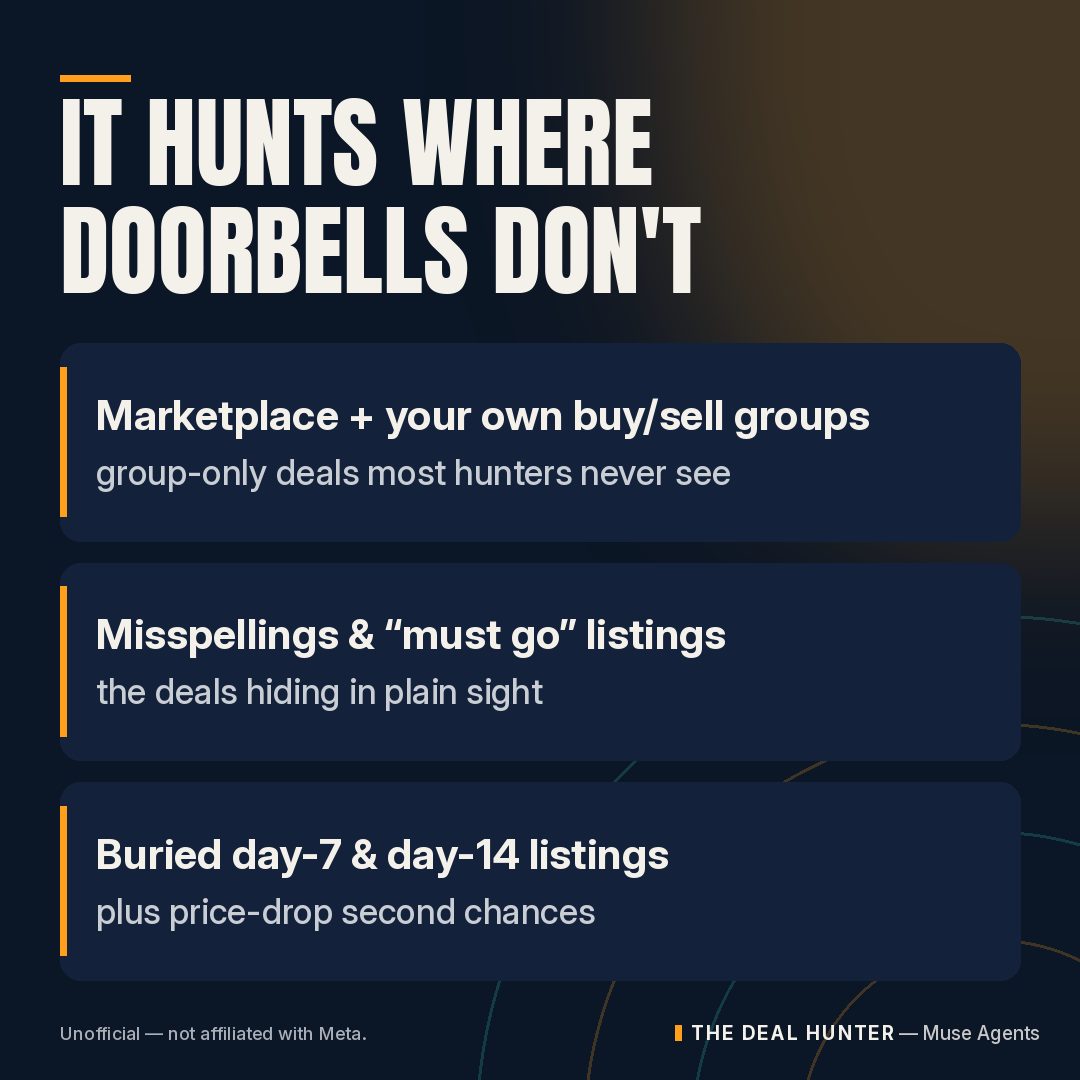
Most alerts only watch Marketplace. This one also reads the buy/sell groups you already belong to — where estate cleanouts, attic boxes, and moving-sale lots land first, usually priced by someone who has no idea what the key items are worth.
It catches the misspellings sellers actually type — "pokeman cards," a Mantle spelled "Mantel," set names nobody gets right — and it goes back for buried listings at day 7 and day 14, when the box nobody recognized becomes a box with a flexible price.
3
Junk dies before it reaches you
Over-cap prices, wrong towns, modern junk wax priced like vintage, "reprint" hiding in the fine print, dealer booths, stuff you already saw. A filter kills each one before it ever gets near your phone.
Then comes the last test, the Stop-The-Truck test: would a sensible hunter actually drive over and buy this? If not, it's gone, however good the numbers look on paper.
 Get it for $39 — Founding 25
4
It zooms in so you don't have to
Before it pings you, it studies the photos the way you'd study them with a loupe. Which set? Which year? Is that the key rookie on the binder page, or the common sitting next to it? A real mint mark and a readable date on the coins — or a jar of pocket change priced like treasure? Pack-fresh or played-with on the games, and is that label even real?
If it can't confirm it, it doesn't send it — and the brief flags what to check in person: corners and centering, water damage, cleaned coins (a shine that kills the value), fake labels and resealed boxes. Hope is not a verification step.
"I couldn't verify" is a full answer. No guessing.
5
Honest numbers, labeled
Asking price, sold comps, and estimates are different things, and every brief labels which is which. And for collectibles there's a hard rule: graded and raw are never blurred — a PSA 10 price is not your raw card's price, and the brief says which one it's quoting. If comps are thin, it says "thin comps" or "my estimate" instead of making one up.
Keeping the key for your PC? The brief tells you what it actually sells for. Flipping the rest of the lot? It does the math: sold prices, minus fees and shipping, minus the drive. One good item can carry the whole box — if the numbers are real.
6
A brief on your phone. You send the message.
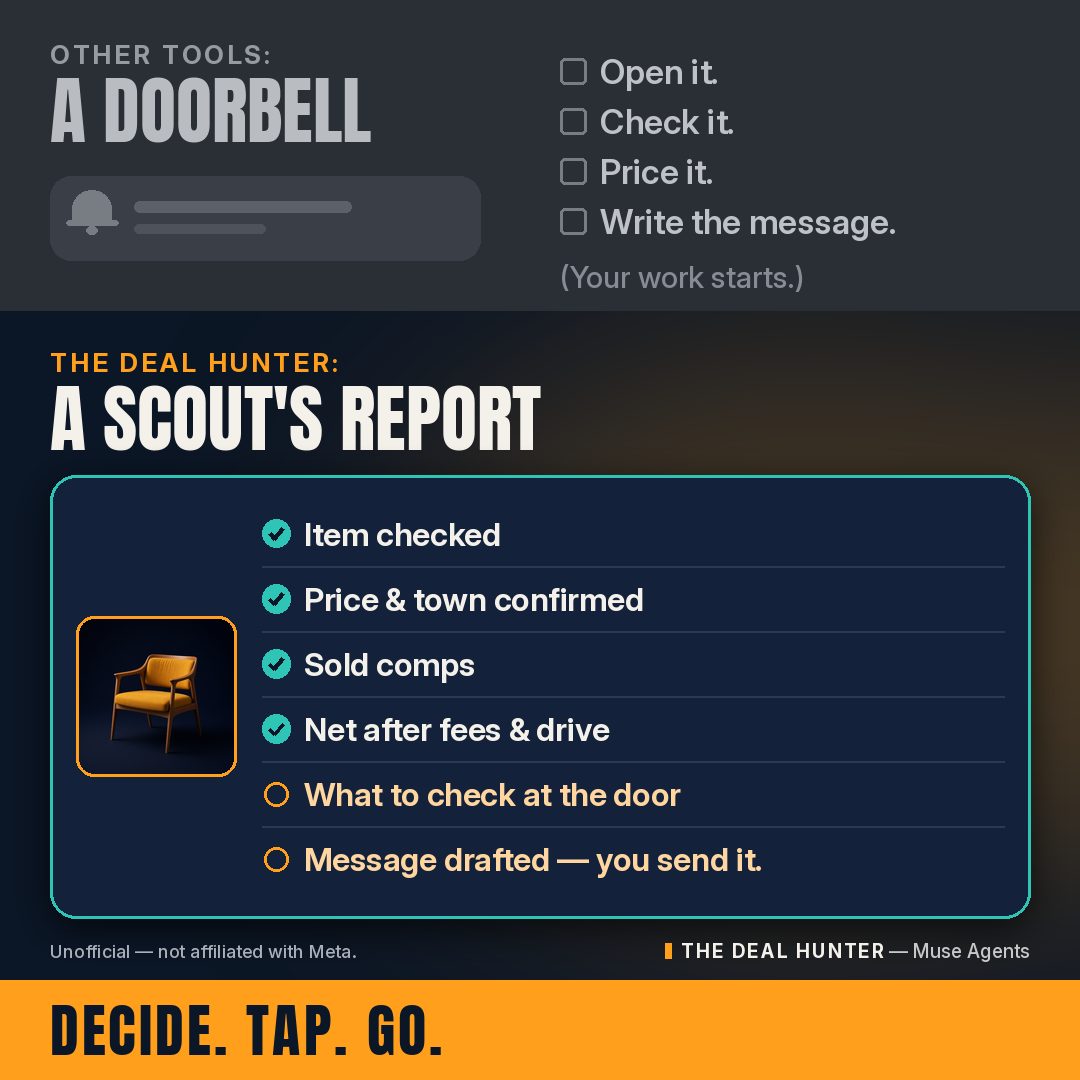
When a find is real, you get a short brief: why it made the cut, what to check at the door, and a first message already drafted in your voice.
You read it, tap send yourself, and go. It never messages sellers. That's on purpose.
The Deal Hunter · sample brief
Box of old baseball cards — $45
Marketplace · listed 9 days · buried lot
Photos studied — binder pages visible
Price & town confirmed
Comps labeled (raw — not graded)
Watch for: reprints, water damage. Ask for corner close-ups.
Drafted — you send it"Hi! Is the box of cards still available? I can pick up today with cash. Any chance of a closer photo of the binder pages?"
Decide. Tap. Go.
Illustrated example. Made-up listing.
7
Pay once. No monthly bill.
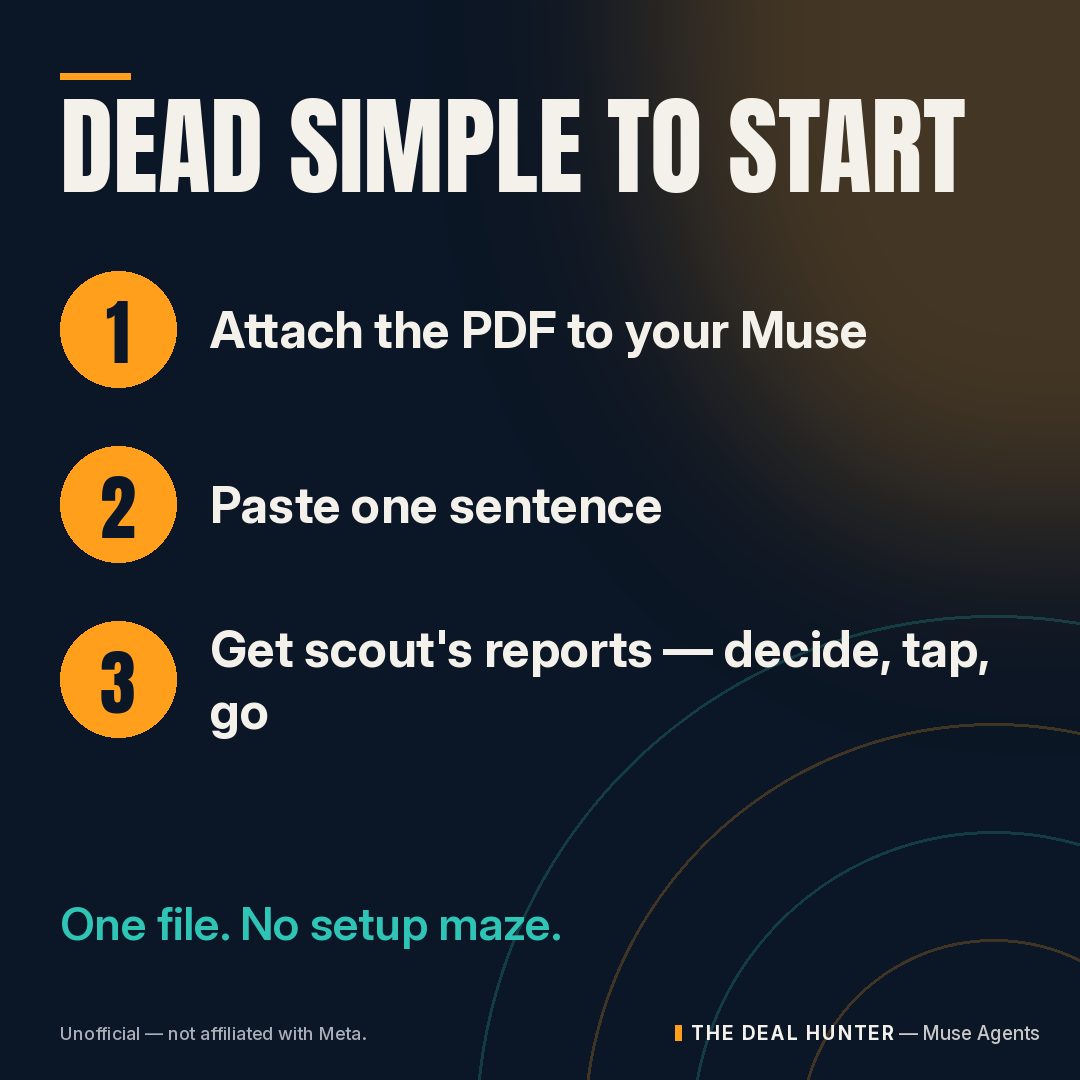
No subscription. You get one PDF. Attach it to a chat with your Muse, paste one sentence, and your Muse sets itself up by asking easy questions. If you're unsure, say "you pick."
It runs on your own Muse and your own Facebook account. You never type a password into a chat.
 Get The Deal Hunter — $39Founding 25 · one-time
 Muse Agents · for Meta Muse